Books Aren’t Movies
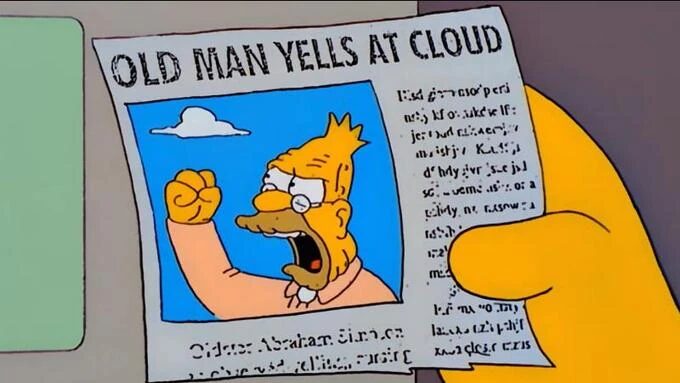
I’ve become old, Chat. Every morning I look up at the sky and I see those fucking clouds, and like a wolf gazing upon the full moon, a howl builds in my chest and bursts forth. I couldn’t stop it if I wanted to, but I don’t want to. Today I saw a cloud in the shape of an author, an author who described his writing style as “cinematic.” Regrettably, the newspapers were there to capture this moment.
Recently on the podcast, we covered Star Wars: Thrawn Ascendency: The Greater Good (Book II) by Timothy Zahn. We have a mixed relationship with Thrawn and Zahn on this podcast. Some of the Thrawn books are quite good. Some of them fall into the trap that novels set in established multimedia intellectual properties often fall into: they are products first and stories second. Perhaps the greatest advantage that novels have over media like video games and film is that they are a direct communication between author and audience. Certainly there are editors and beta readers who provide feedback, but ultimately it is the author’s words on the page. This advantage is lost when it comes to novels set in an established intellectual property.
The author is demoted to a mere partner in the process, and while every arrangement is different, the financial interests of the rights holders will always be paramount. For example, the rights holder will be reluctant to allow any major in-universe characters to be killed, nor will they allow any major changes to the in-universe status quo. They would prefer to save such exciting developments for one of their more profitable mediums. At the same time, the audience for the novel will expect at least some of the flavor of the original I.P. in the book. It’s a difficult needle for an author to thread.
Setting aside the possibility that this Star Wars novel might be some avant-garde experimentalist masterpiece, we know that our story will need characters who engage with a plot. We know that our plot needs to have minimal impact on established timelines and future projects in the franchise, unless we have prior authorization. We also know that there are at least some boxes from the established franchise that need to be checked, for example, space ship battles. The challenge placed before the author, in essence, is to tell an engaging story that doesn’t matter and doesn’t change anything about the characters or the world they live in.
In ancient times, Greek poets and writers would invoke the muse. They saw creativity as a force outside of themselves that they tapped into and channeled through well-honed skill into the making of art. That is a very flowery way of describing a very real phenomenon that occurs during the process of creation. Artists seldom create exactly what they envisioned in exactly the way that they envisioned it. Tales have a tendency to grow in the telling. Plot lines and character moments come about that surprise the writer almost as much as they surprise the audience. Rigid adherence to an outline is not often in the interest of telling the best story. But we’re not here to tell stories. We’re here to create a value-add for the brand.
Enter the “cinematic” writing style. Writers who find themselves in this situation (and writers who are primarily influenced by these sorts of novels and/or by mediums other than books) are sometimes drawn to the “cinematic” writing style. Film has its own advantages as a storytelling medium. A film can have a lackluster script and still dazzle it’s audience with audio-visual spectacle. Ironically, every Star Wars movie after Empire is an example of this (fight me). When a writer describes their style as “cinematic” they could be referring to an attempt to match the pacing and structure common to modern film and television, but more often they mean that their writing is devoid of any emotional or intellectual content that may keep the reader engaged, and instead, they will be describing an arbitrary number of action sequences and set pieces to you that would be impressive if you could see them. But you can’t see them. Because it’s a book. They could have done a comic book, I guess, and then you could have at least seen a picture of what they’re describing to you, but that was not in the budget. If the book does well, maybe there will be a comic adaptation in the future.
My pet theory with the Thrawn Ascendency trilogy is that Timothy Zahn had the freedom to create one book’s worth of lore for the Chiss and Thrawn and maybe half a book’s worth of plot to hang it on. Whether this is due to a lack of ideas on Zahn’s part, or restrictions from Disney either on content or deadlines, I don’t know. I suspect that in addition to this relative lack of material, the decision was made very early in the process that this would be another trilogy of novels. Perhaps they’ve found that trilogies are more marketable. Perhaps they wanted the page count to add gravitas to a character they’re trying to build up for future projects. Regardless, Zahn found himself in a position where he needed to stretch his material into an endless series of military engagements with no stakes, involving characters we aren’t connected to and will not remember fighting for causes that they barely comprehend. If a defender of this novel can name 5 characters from it (other than Thrawn) a week after reading it, I will edit their name into this blog post as a symbol of their victory.
Imagine if between A New Hope and The Empire Strikes back we needed to have 3 additional movies describing every minor military engagement that lead to the rebels hiding on Hoth. That is what Thrawn Ascendency is. Everything you care about happens after this trilogy ends. There is a reason Ascendency is not the first Thrawn that Zahn wrote for the new canon, even though it takes place before the Imperial trilogy. No one who only has this trilogy for context would care about it.
I’m sure there are people out there who will disagree with my definition and assessment of cinematic writing style. I’m sure there are authors out there who write incredible books and also describe their approach as “cinematic.” But as I gaze up at that Kevin J. Anderson shaped cloud, I can only think about the term being used as an excuse for writing that is bereft of engaging ideas, relying instead on the description of spectacle and the vain hope that the reader’s imagination will create something more interesting than the words on the page.
The novel often becomes the medium of last resort for authors who would prefer to work in another medium but lack the skill or opportunity. Film making, video game development, and visual art require specialized skills and budgets in excess of simply putting words on a page. For example, I’ve been thinking for some time that I should take some of my more successful blog posts and turn them into video essays. They would reach a wider audience. They would be much easier to monetize. But I don’t do it because recording and editing a video is orders of magnitude more time consuming than clacking away at my keyboard. There are numerous examples of creators who really wanted to make something other than a novel, writing a novel to prove that there is interest in the project. Clive Barker’s Hellbound Heart, which served as the proof of concept for the Hellraiser films comes to mind.
There’s nothing wrong with taking advantage of writing’s relatively low barrier to entry to get an idea out into the world in some form, even if it’s not the form the creator would prefer. I suspect that this is exactly what Disney is doing with its investment in Thrawn. But creative writing is more than just putting words on a page. It is a craft in its own right. Artless descriptions of complex, choreographed action sequences is not going to cut it. The characters need to have arcs and/or the prose needs to be pleasurable to read. It takes time to craft a meaningful arc and beautiful prose. Unfortunately, time, as we know, is money. Books aren’t movies. You can’t just create a 10-year phased content plan with no wiggle room to let the projects breathe creatively and expect it to resonate with audiences…
Actually, now that I think about it, that doesn’t really seem to be working for their movies either. Huh. Maybe books are movies?