LitRPG Is Romantasy For Boys And That’s…Fine?
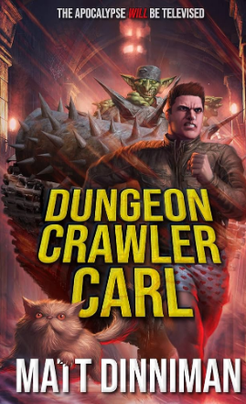
Dungeon Crawler Carl has sold over 14 million books since its release. This puts it up there with series like Sarah J. Maas’s A Court of Thorns and Roses series, James SA Corey’s The Expanse series, and Rebecca Yarros’ Empyrean Saga. Like Sarah J. Maas with Romantasy, Dinniman has created the holotype novel of a new genre: LitRPG. Neither Maas nor Dinniman invented their respective genres, but as far as the general public is concerned, they have come to typify them. Romantasy has its roots in the combination of bodice-ripper romance books with the slash fiction of fantasy fanfiction communities. LitRPG is deeply rooted in gaming, isekai, and web novel communities. Both of these genres existed in niche obscurity for a relatively long time before breaking out into the mainstream. Upon arriving in the mainstream, both genres found an enthusiastic and underserved group of readers whom the publishing industry had long since given up on trying to reach.
I would wager that most readers are not familiar with things like Wattpad, Royal Road, or Shosetsuka ni Naro. These are platforms that cater to amateur writers looking for a place to publish their work where it might actually find some readers. They also cater to readers who are hungry for content. What these platforms may lack in mainstream recognition they more than make up for in sheer prolificacy. It’s not unusual for writers to put out multiple chapters per week and it’s not unusual for readers to demand more. While this pace is not necessarily conducive to quality, it does create an environment of rapid evolution. New ideas are quickly prototyped and market tested. Feedback rolls in instantaneously. Other writers pick up on successful trends and continue the process of adaptation and iteratation.
The literature that evolves in this environment tend to be very “idea forward.” Which is to say that ideas matter more than execution. Some series on these platforms are professional, polished, and every bit the equal of what you would expect from traditional publishing. They are the in the minority, though they do tend to rise to the top. In the middle you will find writers taking big swings and readers looking for something more intense. Whether your particular poison is sexy spicy romance, endlessly crunchy magic systems, or qi blasting martial arts mayhem, these platforms have treasures to satiate desires both subtle and gross.
Romantasy and LitRPG both crawled from this literary primordial soup. Partially because they originated in this new world and not in literary magazines with respected editors, they are both considered “lesser” genres of fiction in a market that still considers all “genre fiction” to be the lesser alternative to so-called “literary fiction.” Science-fiction, fantasy, mysteries, thrillers, and yes, even horror and romance, have developed well-organized communities of literary professionals to review and promote work within the genre. These professional communities serve a purpose beyond just writers giving awards to other writers. They create an air of legitimacy and respectability around their genres. They serve as arbiters of taste, filtering or contextualizing the bizarre and the unrefined. These organizations still have their role, but their importance has waned as the influence of the traditional media they were built on has waned. Readers are no longer looking to newspapers and magazines, nor even to blogs (alas) to tell them what to read. The professional curators and tastemakers have been scooped by the influencers.
Increasingly, the success of a book is determined by its ability to find favor and algorithmic success with book-influencers on various social media platforms. Booktok, bookstagram, and booktube are arguably now the key drivers of a book’s financial success. These influencers tend to be young, chronically online, and unconcerned with being traditionally “well-read.” Their tastes are shaped by entirely different kinds of storytelling. Many of them discovered their love for reading and writing online in the aforementioned fanfiction communities and web novel communities. They do not share the industry’s bias against books from these humble origins. In fact, the industry looks wholly different to them. Theirs is a world where audio books and kindle direct publishing are at least as important to their literary consumption as traditional paper books bought in a shop or loaned from a library.
We need to take a step back at this point and re-examine why the more “professional” organizations have ignored (or looked down upon) the growth of self-publishing platforms. I believe it is more than just the rough-around-the-edges nature of the writing. It is the content itself that they take issue with, and to some extent, I share their distaste. Romantasy and LitRPG both deal heavily in wish fulfillment fantasies. Their characters tend to be the prettiest girl at the ball (who also has super powers) or the downtrodden nerd who is transported to a world where everyone finally appreciates him (and he also has super powers). Readers are meant to project themselves onto the protagonist and experience the vicarious thrill of utterly dominating every obstacle that crosses their paths. There’s just enough challenge to make the domination look cool, but there’s never any real danger of things not working out for the protagonist. It’s a dopamine rush. It’s addictive. And unlike so many other forms of entertainment these days, it’s cheap. If a reader adjusts their standards a bit, there is an endless supply of free content available. These genres have gained a reputation for being literary junk food, but it’s worth examining if they might not be more accurately labeled as an opiate of the masses. In an age where the stock market hits new highs while more people fall into poverty, perhaps the “quality” of legacy media is a luxury “medicine” that many can no longer afford.
The old guard does also seem to forget that the same criticisms they lob against Romantasy and LitRPG were once thrown at the material that they hold dear. The novel itself was considered to be simple entertainment devoid of any intellectual merit. When a new form of entertainment becomes popular it usually comes with a flood of new work, most of which are forgettable, amateurish, and…well…bad. For every Isaac Asimov there’s a dozen Kevin J. Andersons and a thousand L. Ron Hubbards. Much like for every Court of Thorns and Roses or Dungeon Crawler Carl there are a thousand Kiss of the Basilisks and Brad the Impalers. As time goes on, genres mature. They produce pillar authors and works that achieve mainstream success. They build audiences and commentary communities that are capable of filtering out the bad, finding the good, and explaining the misunderstood.
Eventually, if they remain popular, which industry trends suggest they will, these genres will produce something with a little more intellectual heft that the academic crowd will recognize and celebrate. The real question may be whether academic literary institutions survive to see it. Academia, particularly the humanities, is not in a great place right now. The middle class is vanishing. Tuition is increasing. The only consistently hiring industry in the United States is healthcare. Alongside all of this we are entering new social territory with the death of the monoculture. The audience of any media criticism has fractured. Formal media criticism is drowned in a sea of microblogs, video essays, and podcasts by self-appointed, underqualified pseudo-intellectuals.
There is a palpable frustration from the old school with these new genres that seem to cater to the escapist wish fulfilment of the masses rather than challenging them to rise up and fix things. Combine this with an ongoing literacy crisis, and many “serious” readers are looking with scorn at adults whose reading lists are composed entirely of fairy smut and video game fantasies. These books are written at about an 8th grade reading level (to be generous), in spite of their mature themes. A case could be made that their market dominance as a sign of skill regression among the general reading populace.
Defenders of the genres will point out that these arguments are elitist and hypocritical. The same could be (and has been) said about every genre. Fantasy was once relegated to children’s bedtime stories. Science-fiction’s popularity has its roots in the pulp magazine “cowboys in space” serials of the 1920s. Even Shakespeare was considered drivel for the masses in his day. Shouldn’t we just be happy that something is getting people to read at all? Long form content in the year of our lord 2026? For God’s sake, take the win!
My personal thoughts are somewhere in the middle. Buddhists monks spend years in meditation, attempting to see reality as it truly is. They do this by attending to their breath and staring at walls. These are among some of the most worthwhile activities a human being can engage in according to a number of masters for whom I have a deep respect, and neuroscience seems to support it as well. In Buddhism there is something called The Noble Eightfold Path. The Noble Eightfold Path consists of eight practices that, when done correctly, lead to the cessation of suffering. They are: Right View, Right Resolve, Right Speech, Right Conduct, Right Livelihood, Right Effort, Right Mindfulness, and Right Concentration. I’m going to simplify things quite a bit here, but there is nothing about breathing or wall-gazing that is inherently enlightening. If one does not practice with the Right Effort, Right Mindfulness, and Right Concentration then the meditation time will be wasted. Likewise, if one leaves the meditation space and goes on to an evening of binge drinking, sex, and violence then any progress made will be swiftly undone.
I mention all of this Buddhist philosophy because I think it applies equally to intellectual pursuits like, for instance, reading a book. Any book can be thought provoking if you think about it. If one approaches their reading with Right Effort, Right Mindfulness, and Right Concentration then I believe that any text can show its reader something valuable. Some books lend themselves more to this pursuit than others. I don’t think that Dungeon Crawler Carl and A Court of Thorns and Roses are trying to cultivate a rich intellectual experience that leaves their readers better for the reading. At the same time, I think that many authors who set out to do just that wind up engaging in pompous lecturing that ultimately falls on deaf ears. A trashy book can be life changing, and a lauded literary classic can be tedious egotistical rambling. Meaning is always created in the mind of the reader.
While I think that Dungeon Crawler Carl and A Court of Thorns and Roses are both harmless and neutral, I do think that most of their readers enjoy them as a distraction. They do not demand that the reader think about them in the way that some literary classics might. When the reader is in the book they don’t have to be present. A little bit of that is fine. Very few of us are Buddhist masters who can dedicate every moment to the path of mindfulness. We all need a break from time to time. With that said, remember that these are genres with a tendency towards heavy consumption. Readers of Romantasy and LitRPG tend to read a lot and they tend not to be very picky. Too much distraction is a legitimate problem and, in keeping with my Buddhist analogy, wish fulfillment fantasies are especially dangerous. Wishing for things to be other than they are is literally the source of dissatisfaction and suffering in Buddhist philosophy (and Stoic philosophy, and a lot of other philosophies, look, unrestrained desire is bad especially when practical action is not taken or is impossible).
I do think that Romantasy and LitRPG are a little more ripe for abuse than Fantasy and Science Fiction, but only a little. Humans are good at finding ways to escape reality, especially when we dealing with it would be difficult. Ultimately, the problem lies with the reader and not with the reading material. If you are a passionate fan of one of these genres, I would encourage you not to become a passive consumer. Try your hand at writing, criticism, or commentary. It will benefit both yourself and the genre. It will engage you with a community of people. Engagement has been the key to the maturation of genre, and it is what we need in Romantasy and LitRPG. To the community’s credit, I think many are heeding this call.
