What I Read in 2025 That I Didn’t Cover on a Podcast
A little about my reading habits
This list grows shorter every year, not because I’m reading less, but because I’m podcasting more. My goal is to read about 50 books every year, roughly one per week. Depending on your level of engagement in online book spaces, that may seem like a lot. As a book “influencer,” though, this is on the low end. I attribute this slowness to my not being a particularly fast reader and to the diverse range of material I engage with. I can read a 400-pages of fairy smut in a few days, whereas something like The History of Spiritualism can turn into a month-long fact-checking nightmare.
I track my reading on Goodreads. I don’t particularly like Goodreads. It’s slow. It lacks features. But it gets the job done, and I don’t care enough about the tracking aspect of my reading to switch platforms at this point. With that said, one of the critical features that Goodreads is lacking is the ability to track serialized literature. There are hacky ways to do it, but for the most part, until something is collected into what is recognizably “a book,” Goodreads doesn’t know it exists. I read a large number of articles, essays, studies, comics, and stories that are not easily trackable on Goodreads. I probably won’t mention any of that “side reading” here, but I might talk about it in a later post. What I discuss here is what was easily tracked on Goodreads.
I will be grouping books on related topics into sections for convenience’s sake and to compare and contrast books on the same topic for a reader who might only have time to check out one. Here we go.
Background Reading for Talking About Tolkien
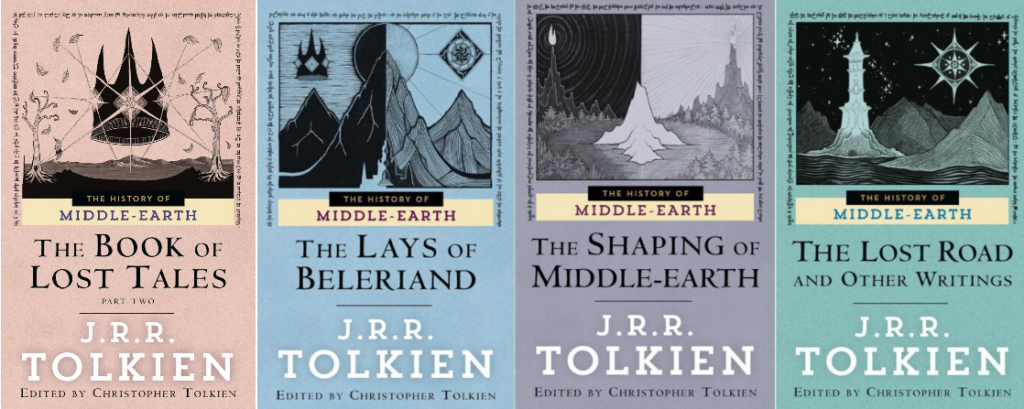
I’ve been working my way through The History of Middle-Earth 12-volume series that was compiled by Christopher Tolkien following the release of The Silmarillion. I’ve owned these books since I was in my early teens, but I’ll be honest, they proved a bit too dense for Young Ben. After starting a Tolkien podcast in my middle age (possibly the saddest start to a sentence I have ever written), I decided it was time to tackle them again. This second attempt has been orders of magnitude more successful.
These volumes contain Tolkien’s early drafts, notes, and alternate versions of the material that would become The Silmarillion and The Lord of the Rings. To write The Silmarillion, Christopher Tolkien needed to compile and organize a large number of documents, most of which were handwritten in varying degrees of legibility. These documents were not intended for publication, and so Tolkien did not dumb them down for the modern reader with little knowledge of Old English, Old Norse, and Philology. In addition to the real-life ancient languages that Tolkien often references and switches between, Tolkien’s conception of the Elvish languages changes with each new draft. The vocabulary is constantly evolving, especially with regard to names. The task of parsing these drafts requires the help of someone who is both an expert in the ancient languages of the British Isles and Scandinavia, as well as someone who is an expert in Tolkien’s constructed languages. Christopher Tolkien does an admirable job.
The books are equal parts original material created by J.R.R. Tolkien and Christopher Tolkien’s annotations and commentary on that material. They are fascinating, and I am immensely grateful to have them. They are not for casual fans of Middle-Earth, though. They often contain multiple versions of the same story and detailed conversations about linguistics and names. The series is an excellent walk-through of Tolkien’s thought process, but it’s painfully thorough. I can only recommend it to serious Tolkien-heads.
Background Reading for Words About Occult Books
Words About Occult Books requires more research than any of my other projects. The thing about Occult books is that the vast, vast majority of them are attention-seeking garbage from self-appointed gurus. I’m not particularly interested in the ramblings of cynical new age grifters. I’m interested in people’s genuinely held religious, supernatural, spiritual, and magical beliefs. I’m interested in scholarly research into how these beliefs have developed over time. As you might imagine, though, it can be difficult to separate someone’s genuine belief from a committed grifter’s sales pitch. Academic and historical sources tend to be rare and/or expensive. I like to read a number of books on these topics before I decide on one to structure a conversation around. When it comes to the subject of Gnosticism, I’m still searching for that book.
For those who don’t know, the Gnostics were an early and diverse branch of Christianity whose philosophy and theology put them at odds with the Catholic church. For most of history, this movement was only known from the writings of church fathers denouncing it. In 1945, a hidden cache of Gnostic texts was found in Egypt and reinvigorated interest in the movement. Elements of these texts worked their way into a lot of modern occult thinking, making them an important subject of study for anyone looking to understand the occult.
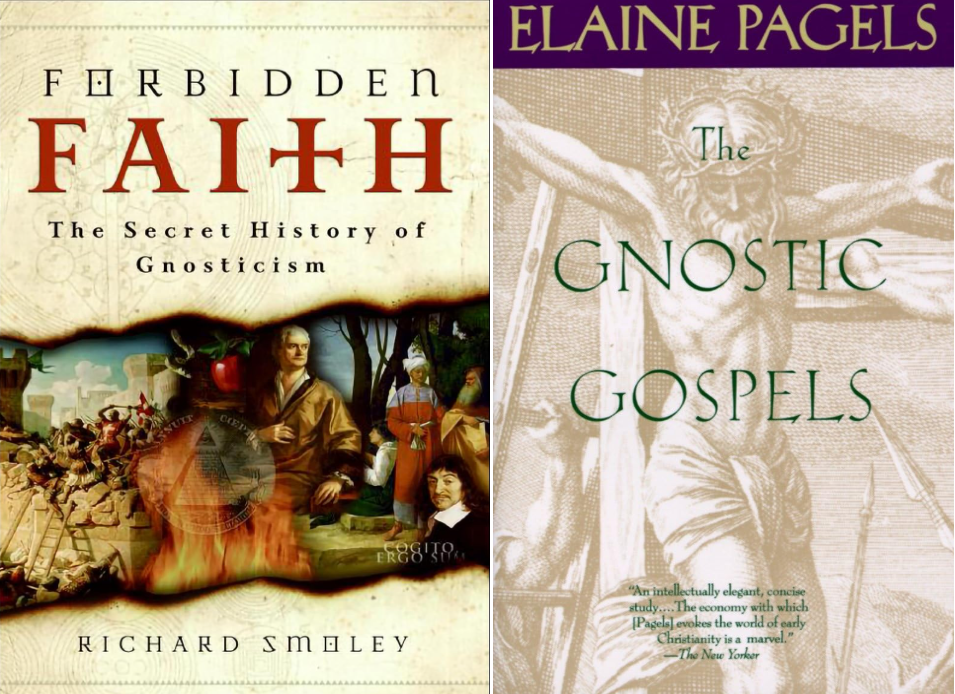
I decided to check out two books that are often recommended as good introductions to Gnostic belief: Forbidden Faith by Richard Smoley and The Gnostic Gospels by Elaine Pagels. Smoley and Pagels both cover a lot of the same material regarding the history of the movement as it struggled against the increasing authority of the main church. Smoley makes more of an effort to demonstrate how Gnostic ideas of influenced modern art and culture, with mixed success. Pagels’s book is the one I would probably recommend, but I found it put maybe too much emphasis on the history of the movement and not enough on the actual theology of the movement.
Buddhism
I’m a fan of Buddhist philosophy and meditation practices. In my struggles with mental health, I’ve found mindfulness helpful, but the pursuit of mindfulness less so, if that makes sense. For such a seemingly simple subject, the practice of meditation, mindfulness, zazen, whatever, is a never-ending learning process.
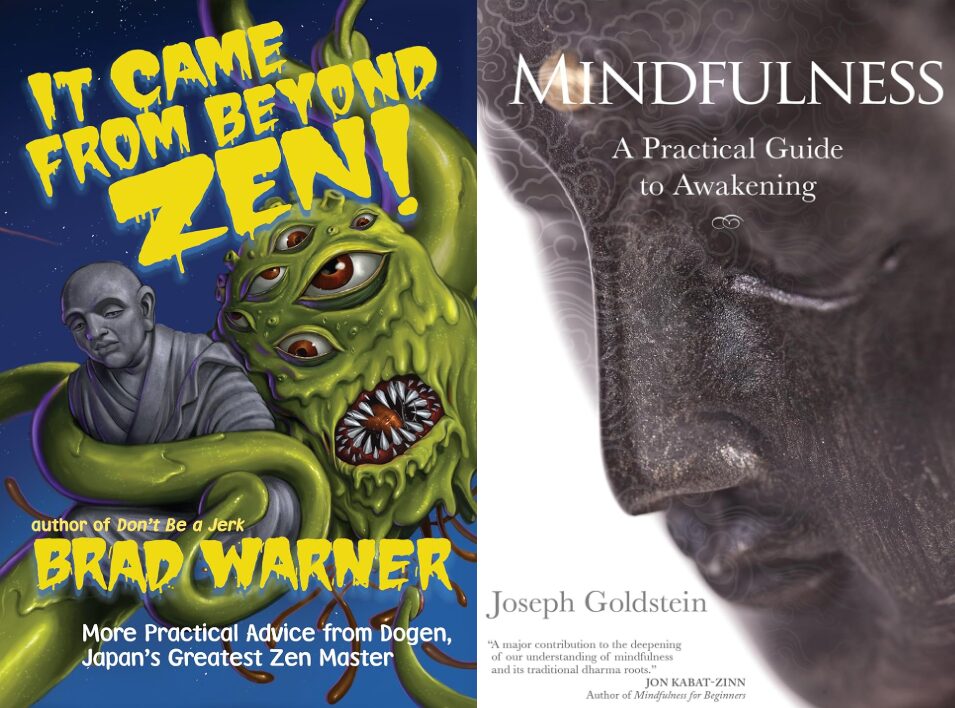
Brad Warner and Joseph Goldstein are very different people. Goldstein is probably closer to what most Americans imagine when they picture a Buddhist. He is very calm, peaceful, reflective, and ecumenical in his approach to Buddhism. He is well read in many different sects of the religion and quotes from them liberally throughout Mindfulness. Mindfulness is probably the book that I would recommend to new meditators.
Warner, on the other hand, is a bit of a polarizing figure. He is not a lovey-dovey, calm, cool, and collected monk. His political beliefs skew aggressively Libertarian, and going right along with that, he has a real need to be a contrarian. He is the author of Hardcore Zen, which follows his experience in the seemingly unrelated worlds of the Hardcore music scene and Zen Buddhism. It Came from Beyond Zen! is the second in a series Warner wrote on the philosophy of Dogen, probably Japan’s most famous Buddhist monk. Dogen is known for being difficult to understand. His writing is more a series of thought exercises than a direct transmission of knowledge. For all his faults, Warner’s admiration for Dogen is genuine, and he does a good job of paraphrasing the master. I’d recommend his series if you’re interested in Dogen’s writings, but find them difficult to parse.
Manga
I’ve been a big fan of comic books my entire life. I got into manga when I was young, and Japanese language and culture quickly became an interest of mine. I don’t get to read as much as I did when I was a kid, but I still try to make time for a few each year.
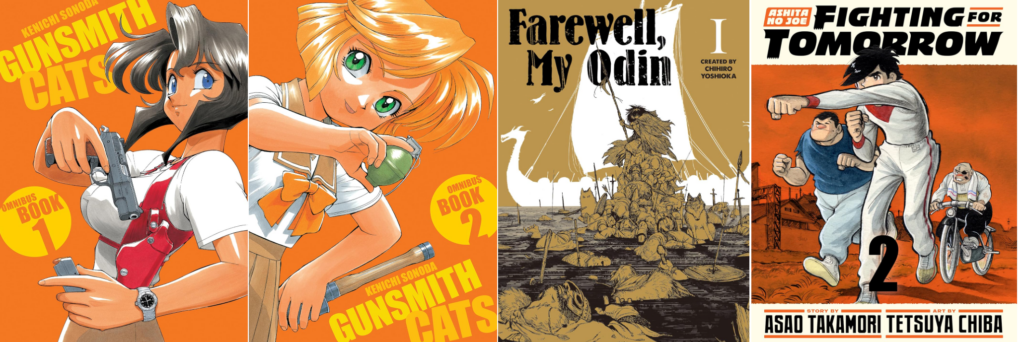
Gunsmith Cats recently got a rerelease after being difficult to find for a few years. I love Kenichi Sonoda’s art. I love his pulpy storylines. I don’t love his fixation on underage girls and age gap relationships, though. While Gunsmith Cats is a classic of the medium, the sex stuff is much worse than I remember, and it makes it very difficult to recommend.
Japan has joined the Viking Mania that has gripped America in recent years. Vinland Saga, a manga retelling of the Norse Saga of the same name, is insanely popular. In the wake of that success, there have been a handful of other attempts at manga inspired by Old Norse culture. Farewell, My Odin is a decent manga that has the vibe of a Norse saga with probably my favorite art of any of these recent Viking manga, including Vinland Saga.
Ashita no Joe is an absolute classic. It is a sports manga about a young delinquent turned boxer. It has only recently been officially translated into English, and it is worth a look for anyone interested in the history of manga, the gekiga movement, or anyone who is a fan of sports manga.
It’s not pictured above, but I also read I.L. by Osamu Tezuka. Tezuka is widely recognized as being the father of manga. He’s probably best known for creating Astro Boy (Tetsuwan Atomu, in Japan). Tezuka’s style was synonymous with manga after World War II. In the 1960’s, Tezuka’s influence began to wane. New artists were interested in pushing the medium in darker and more mature directions. The childish manga of Tezuka gave way to the gritty gekiga of artists like Kazuo Koike, Masahiko Matsumoto, and Seiichi Hayashi. Tezuka was not one to fade quietly into the pages of history, though. He attempted to adapt and create gekiga of his own. I.L. is one of his failed attempts. It is a bizarre story of a man who failed as a film director, but is then gifted with the supernatural power to direct reality. To accomplish this, he is given the perfect actress, a woman named I.L. She can transform herself into anyone or anything. Together, the two take on bizarre cases, often dispensing poetic justice. It’s not good. It’s a strange, flailing attempt at relevancy that I thoroughly enjoyed, but can only really recommend those with a deep interest in Tezuka.
Miscellaneous
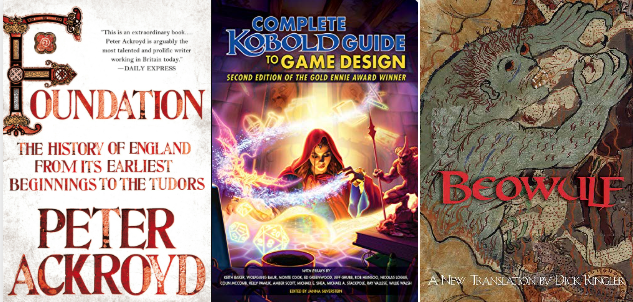
I always try to carve out some space for non-fiction reading on topics that I’m interested in. This year, I didn’t manage to carve out as much space as I would have liked.
I’ve been interested for a long time now in getting a better understanding of the history of the British Isles. I come from a family of engineers who were very insistent that the only education of any real value was math and science. I’ve always had an interest in the visual arts and literature, but I didn’t pursue them much in my university days. My interest in English literature has always tended towards the medieval. To really understand medieval literature, it is helpful to understand the cultures that produced it. My American education treated the British Isles as a homogenous unit that was synonymous with “England.” This is a gross misrepresentation of the reality. The complexity of the languages, cultures, and ethnic groups of the British Isles is vastly underestimated in most American textbooks.
Foundation is a series of books on the history of England by English biographer Peter Ackroyd. I was particularly interested in this first book, which claims to take us from the Stone Age to the Tudors. I wanted an overview of early human history in the area before I looked for books that went into more detail about specific periods. I think I got that from Ackroyd. Next year, I hope to have some time to dive into some more focused, academic histories. I don’t think I will continue with Ackroyd’s series, though.
Ackroyd is a highly opinionated writer, and he doesn’t really try to hide it. I found this off-putting in a book that claims to be “the history” of a nation. Ackroyd also seems to be in quite a rush to get to The Tudors. You get the sense, reading the book, that this is when he feels that English history really begins, or maybe that’s just when he starts getting enough material to really work with. This is another area where Ackroyd’s lack of historical credentials may hurt him. He cannot read the old texts for himself. He doesn’t participate in any kind of archeological research. He is reading the sources that are accessible to him and presenting them. As a podcaster, I find nothing wrong with this, of course. I’d just like to go a little deeper.
Beowulf kind of goes along with this. I debated including this one in the background reading for Talking About Tolkien. I wanted to reread Beowulf before we got to Rohan in the podcast, so that I could be prepared to talk about it. That isn’t the only reason I had this specific edition of Beowulf, though. I first read Beowulf in high school in Heaney’s translation, which I have since learned some experts took issue with. When I heard that Hackett Publishing was putting out a new translation that focused on readability and tried to replicate some of the rhythm of the original poetry, I was excited. I definitely prefer this translation to the one I read in high school. Other translations have come out since this one was published. I’m not sure if this is the best one out there, but I’d recommend it.
Last, but not least, is The Complete Kobold Guide to Game Design. This is a collection of articles and essays on the craft from various game designers who have worked with Kobold Press throughout the years. For those who played sports in high school, Kobold Press is a famous third-party publisher of modules and supplements to various table top role playing games, especially Dungeons and Dragons. I’ve been dipping my toe into the exciting (and not at all oversaturated) world of RPG actual play content, and I’ve become more interested in (and appreciative of) game design.
The Complete Kobold Guide to Game Design is a little outdated. It hasn’t been updated significantly since 2012, but much of the content is timeless. I don’t know if I’d run out and purchase it unless you’re very specifically interested in designing an RPG from scratch and trying to take it to market. I found it interesting, but I’m more focused on modification and Game Mastering than actually taking anything to publication.
Conclusion
Well, that’s it. Now you know everything I read in 2025. If you really care about my reading journey, feel free to follow me over on Goodreads.